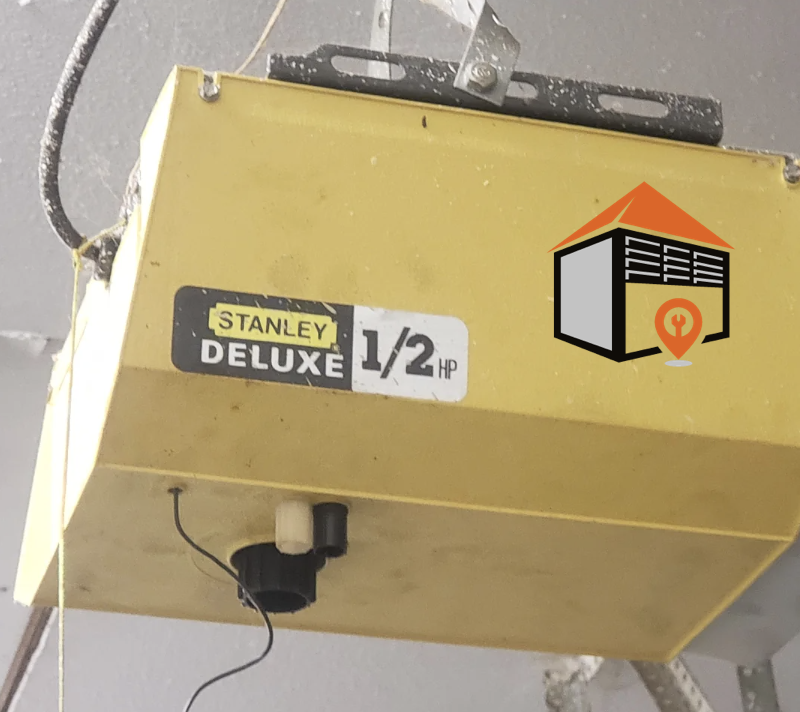
Stanley was once a top player in the garage door opener field. This was particularly true from the 1970s to the 1990s when the Stanley brand was owned by Stanley Works, the same company recognized for making high-quality hand tools and construction hardware. Because of this, Stanley’s garage door openers were known to be reliable and long-lasting products that came at a fair price-point.
Stanley put to use its engineering experience to design these easy-to-use opener systems and get themselves a sizable stake in the garage door opener niche market. During the 1970s, they would even develop some of the first wireless remote-controlled garage door openers in the world.
At the time these products flourished, as most of the competition’s systems were either lacking mechanical and manual functionality, or they didn’t even exist yet. Openers weren’t as popular in industrial settings since their residential unit was not yet a popular commodity. However, it would become so given its ease of use, durability, and simple installation.
Stanley continued to sell garage door openers through the 1980s up until the early 1990s. These products were mainly cheap chain-drive systems. Many older garage owners recognize the names of the Stanley 3000, 3100, 4000, and 5000 series. These systems have a chain that travels along the opener’s rail to lock the door in place or retract it. Other models instead carry a long metal rod along the rail that physically pushes the door into place.
Either way, each of these openers was primarily mechanical. One could easily look at any unit’s rail layout, and without the need for any prior experience, see precisely how the opener would work by watching how the rail moves as the chain or rod moves.
Stanley also manufactured compatible outside keypads, wall control panels, gear kits, rail assemblies, and light bulb covers. The company didn’t have the most substantial lineup in the world. However, they were one of a few brands, like Chamberlain, that tak cared of the few essential bases any homeowner looking for a new opener might need.
The many openers Stanley offered during these years were known for as both reliable easy to use. This is because of their simple mechanical layout. Unfortunately, these products haven’t aged well. Most of the pieces inside them were made from plastic that easily stripped or metal that would warp and wear.
These products often had internal computer memory and circuit boards, but they were the clunky size of cell phones. The older models didn’t even feature the memory and circuit boards unless you paid extra for an outside keypad.
Safety reverse mechanisms and telling beams were also nothing special on these models. These came with their mechanical set up, causing the door to bounce out when detecting the force of an object or person in the door.
The door would then stop and retreat if it tried closing because it was being blocked. This meant the opener wouldn’t need to be replaced but instead, the more affordable replacement of another Stanley opener.
For the most part, Stanley could compete in this market until the federal government began considering stricter safety regulations for the motors. When the regulations finally passed in 1993 and ordered all new opener systems to come with infrared photo-eye objects that prevented the door from closing onto anyone or anything. Most Stanley openers models weren’t retrofittable.